Here I Write
I can do no other.

My conscience is held captive by the Word of God, the good of my neighbor, and the Oxford comma.

“Happy the man who shall then be able to believe that old age itself, with its pitiable decays and sad dreams of youth, is the chastening of the Lord, a sure sign of his love and his fatherhood.”
— George MacDonald
The Gifts of the Child Christ
Ordering time through chapters
(Part 2) …
First, a brief recap from last month.
I ordered the chapters in The Saints of Whistle Grove topically rather than chronologically, because I wanted to tease out the themes of fidelity and eternal joy rather than simply tell the story of a church’s closing.
Still, I didn’t want to underserve the reader by disordering a story simply for thematic purposes. That would be harmful to the reading experience, so I labored to ensure each chapter in Saints posited a question in need of answering and then answered that question in a subsequent chapter. I also reinforced the Q&A-chainlink fence design by weaving characters, places, experiences, dialogues, relationships, and objects in and around each other so that no one chapter could be fully understood apart from the others.
Here is a breakdown (spoiler alert!) of a few of the more obvious questions and answers layered in each chapter. (Why not include all of them, you ask? Because you really do want to discover most of them on your own. Trust me.)
Chapter 1: Saint Miriam, 2018
Q: Why did the little country church close? Who is Aunt Miriam? Is a cemetery all that important to humanity? Is Pastor Oglethorpe a fool? Will the seed planted in Ms. Sally Grisbone bear a crop as bountiful as the graves in Whistle Grove Cemetery?
Chapter 2: Saint Frances, 1951
A: Aunt Miriam is a book-loving survivor of polio. The three Werth women are to be admired and feared.
Q: How did Mr. Werth die? Why does Ruthie Werth not like her farmhand’s wife? Why does Oskar’s family not own any land? Will Oskar prove to be a good friend to Miriam?
Chapter 3: Saint Lowell, 1934
A: The Bloomes lose their land during the Great Depression. Oskar, too, is a survivor. He can walk only because of the benefaction of a Shriner’s hospital in St. Louis.
Q: How, exactly, will physical disabilities affect Oskar and Miriam’s lives?
Chapter 4: Saint Alwin, 1866
A: The founding families of the church in Whistle Grove are the Werths, Bloomes, Freeses, Lindels, and Reinkings, and all are German immigrants. They call their first pastor in the 1860s. The church is given the name Bethlehem by the youngest girl in the grove, Sarah. Alwin Werth, a child, is the first person to be buried in Whistle Grove.
Q: Who will be the first pastor? When and how will the families build an actual church building? Where will they worship in the meantime? Who will be the first in the new congregation to marry, to be baptized, to die, etc.? Why does Ludwig Bloome never notice Lesta Reinking’s frequent attentions?
Chapter 5: Saint Vivian, 2016
A: Bethlehem is a Lutheran church, and it closes about 160 years after its beginning because those remaining in the pews are too few to maintain the property and supply the pulpit. Pastor Oglethorpe is the serving pastor at the time of the church’s closing.
Q: Why did Miriam Werth never marry Oskar?
Chapter 6: Saint Bernice, 1958
A: Marta Werth is a survivor of her older sister’s strong personality. Marta loves Oskar, too, and for longer than Miriam.
Q: Will Miriam’s stubbornness be her undoing? Will she lose Oskar to Marta? Why is there a half-buried wagon wheel in the grove?
Chapter 7: Saint Johann, 1867
A: Ludwig’s father is the first person to die in the grove and, therefore, the first to have a funeral. The wagon wheel marks the grave of Ludwig’s dog, Felix.
Q: What about our pets? Do they go to heaven? Will Ludwig marry Lesta?
Chapter 8: Saint Klaus, 1879
A: Klaus Iken is the pastor of Bethlehem Lutheran, and he and his wife Ina live a full, vibrant life with their many children. Ludwig and Lesta are the first couple to be married in the grove. The school was built before the church. The grove begins to be called Whistle Grove because of the noise the wind makes blowing through the trees.
Q: When will they tear down the rotting barn and build the church?
Chapter 9: Saint Perle, 1882
A: The church will be built where the parsonage, not the barn, used to be.
Q: How will Pastor Iken parent his many children without his wife? Is it better to be barren than to witness the death of your child?
Chapter 10: Saint Noberta, 1891
A: Noberta is a mother in the faith to many children in the grove, though not one of them is born to her. The church has a steeple and bell because of Doktor Frese’s love for his deceased wife. A church bell is used for many purposes in a rural community including tolling the number of years the deceased has lived.
Q: Who is Frieda?
Chapter 11: Saint Ernst, 1918
A: WWI brings with it strong anti-German sentiments in Riverfield County. Pastor Iken is alive and beloved still, but he cannot speak English.
Q: When and how will Bethlehem ever switch to English services? Will Ernst Werth survive the war and marry Renate Freese?
Chapter 12: Saint Orville, 1944
A: The women of Bethlehem form a Ladies Aid Society to keep up with the maintenance of the church while the men fight in WWII. Ruthie Werth and Cherry Daniels, the wife of the Werths’ farmhand, are best friends as are young Miriam and Marta. Ruthie’s husband, the son of Ernst and Renate, dies fighting in the war. Cherry’s husband survives, and Ruthie cannot reconcile herself to the difference in their situations.
Q: If the Daniels family is not allowed to purchase the old house on the Werth farm, how will they ever have the means to own a home?
Chapter 13: Saint Woodrow, 1978
A: Not every pastor appears to be helpful to the proclamation of the Gospel in the community of Whistle Grove. Bethlehem begins to bleed members to other churches, but Artie Lindel and his wife Viola remain faithful to the church.
Q: Will Artie’s fidelity to Bethlehem outlast the current difficult pastor’s tenure? And will Bethlehem survive losing so many members?
Chapter 14: Saint Edgar, 1986
A: Artie’s prayer that the difficult pastor leave is answered, but the new pastor appears to suffer from depression. Georgia, the pastor’s wife, is tempted to lead where and when her husband cannot. Lila Daniels, Cherry’s youngest, has fallen into a life of sin.
Q: How will Bethlehem survive the realm of Mrs, Pastor? Why is Uncle Simeon an old bachelor?
Chapter 15: Saint Ludwig, 1868
A: Ludwig lays the cornerstone of the school in Whistle Grove the day of his wedding to Lesta. It will serve as both a place of study and a place of worship until the church is built.
Q: Who will be the teacher of the new school?
Chapter 16: Saint Helmut, 1922
A: The pastor serves as the teacher of the school, and Frieda Lindel likes to assist. Artie and Viola Lindel were classmates in the one-room schoolhouse in Whistle Grove long before they were married.
Q: How can a congregation ever forget the importance of having a school?
Chapter 17: Saint Frieda, 1948
A: A post-WWII revival in the hard sciences as well as a move to consolidate public schooling in the county threaten to close the little day school in Whistle Grove. Frieda never marries, so she takes comfort in the fellowship of the ladies aid society during this stressful time.
Q: Will the men of the congregation vote to close the parochial school?
Chapter 18: Saint Jacob, 1991
A: Pastor Oglethorpe first learns of Whistle Grove from his dying mother. He visits the grove after her burial and learns that the little school is closed and now serves as a glorified tool shed. Sadly, it appears that the current pastor’s wife has left him. Church life is the agony and the ecstasy no matter how beautiful the setting.
Q: Who is Pastor Oglethorpe, anyway? How and when will he become the pastor in Whistle Grove?
Chapter 19: Saint Mary, 1939
A: Cherry Daniels manages to hide her illiteracy from Ruthie Werth. Together, the friends discover a girl in need of assistance hiding out in the church. The girl gives birth to a baby boy.
Q: Who will be a mother to the baby boy?
Chapter 20: Saint Edmund, 2018
A: Pastor Oglethorpe is no fool, after all. He is humble and wise, so he writes a letter to Ms. Sally Grisbone explaining that a cemetery is not a waste of space, for her family rests there. He explains the grove’s importance to her and her importance to the grove.
Q: How will Sally receive the letter?
Chapter 21: Saint Luke, 2015
A: Miriam and Marta remain at odds even in old age, but Sally Grisbone, Marta’s daughter, loves her Aunt Miriam as well as her mother. Marta continues to harbor their mother’s old prejudices against the Daniels family.
Q: What happened between Miriam and Marta all of those years ago? Did Marta marry Oskar?
Chapter 22: Saint Oskar, 1958
A: Miriam suffers a loss greater than polio. Marta struggles with forgiveness, because she does not trust that she herself can be forgiven.
Q: How does Miriam get along in her remaining years?
Chapter 23: Saint Simeon, 1997
A: Uncle Simeon is an old bachelor, because the love of his life was unrequited.
Q: How is it that stories about “greater love hath no man than this, that he lay down his life for his friend” make us cry? every time?
Chapter 24: Saint Sparrow, 2004
A: Pastor Oglethorpe loves country life and country people. His wise pastoral care restores the Daniels family to the church. He will be buried next to his mother.
Q: Does Lila stay in the church?
Chapter 25: Saint Alma, 2019
A: Pastor Oglethorpe has the last word, and it is wise. Ms. Sally Grisbone comes from a profoundly beautiful line of Christians.
Q: What will Sally do with all of her new books? and with the cemetery?
Chapter 26: Saint Cherry, 2019
A: Sally Grisbone is good soil, after all. Superman is real. Cherry did finally learn to read. The Daniels family does have a home, and it is from — and with — the Werths.
Q: Wait a minute. In Chapter One, did … ?
Have you been missing Bradbury?
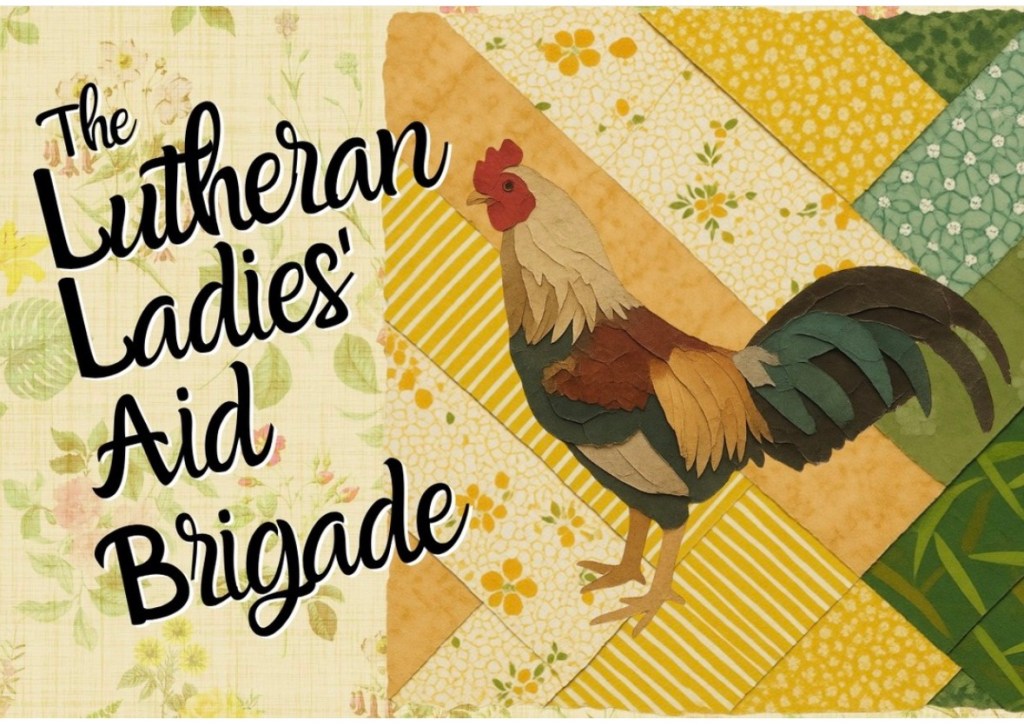
The Lutheran Ladies Lounge podcast invited me to script another parody episode of The Lutheran Ladies’ Aid Brigade featuring our favorite gals from the quilting circle at Zion Lutheran Church in Bradbury, Illinois. Join Mrs, Scheinberg, Bev, Candice, and Nettie (as well as real-life guests Adriane Heins and Lauren Braaten) as they discuss needles, strawberry shortcake, and menopause.
Write with me …
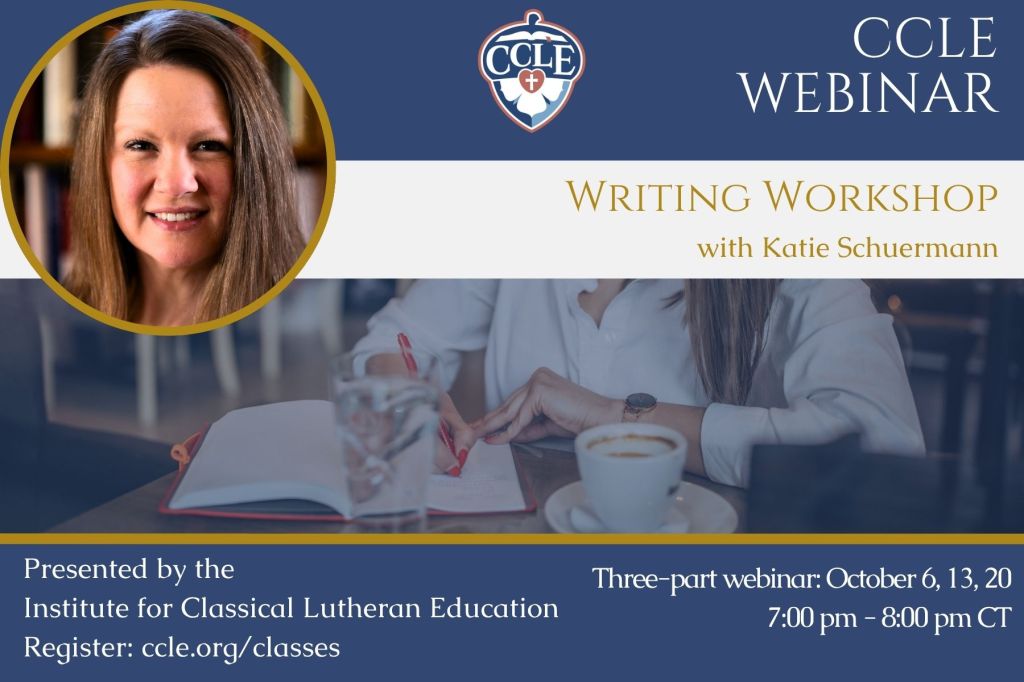
Are you interested in writing and publishing fiction? Join me through the Institute for Classical Lutheran Education for a 3-session webinar on how to create, write, and publish excellent stories, all to the glory of God and in service to our neighbor.
Session 1: Excellence as a means of managing ambition.
Session 2: Editing as a means of managing pride.
Session 3: Publishing as a means of serving the reader.

Katie Schuermann is a baptized child of God, pastor’s wife, and author of The Saints of Whistle Grove; The Creed series, including The Big Father and His Little Boy, The Beloved Son and His Brother, and The Helper and His Apprentice; the acclaimed Anthems of Zion fiction series, House of Living Stones, The Choir Immortal, and The Harvest Raise; and nonfiction favorites such as He Remembers the Barren, He Restores My Soul, and Pew Sisters. When not writing, Katie can be found making music, reading, cooking, gardening, holding babies, or trying to climb the nearest tree.
+ SOLI DEO GLORIA +
Not yet subscribed to Here I Write?

Here I Write, Issue 42
Copyright © 2026 Katie Schuermann, All rights reserved.
 Katie Schuermann